


















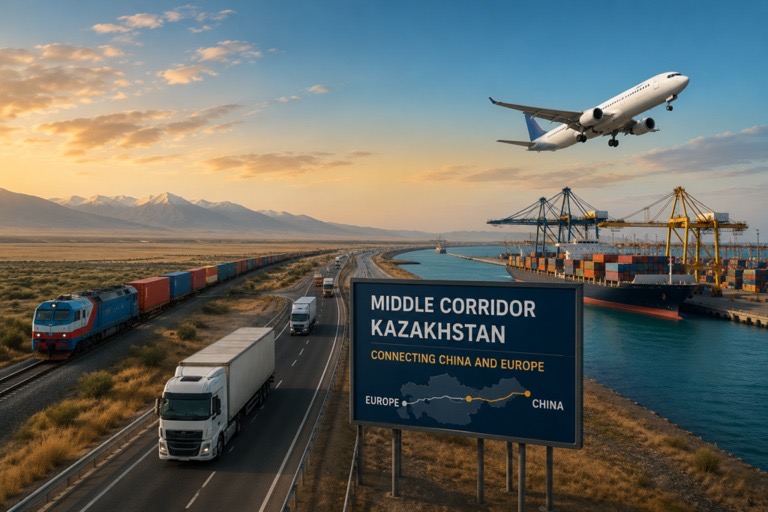
ASTANA, Kazakhstan, August 10, 2026 — Kazakhstan today announced a new milestone in its long-term transport infrastructure strategy with the launch of construction on the Beineu–Saksaulsk highway, a landmark project designed to strengthen the Trans-Caspian International Transport Route (Middle Corridor) and further establish the country as the principal gateway between China and Europe.
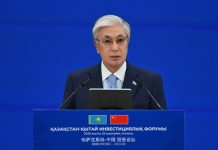
According to remarks by President Kassym-Jomart Tokayev, reported by Qazinform News Agency citing the Akorda press service, the new highway will serve as a “golden bridge” linking China and Europe by directly connecting border checkpoints with the Caspian ports of Aktau and Kuryk. Once completed, the route will shorten freight transport by approximately 1,000 kilometers and reduce delivery times to as little as three days.
The project forms part of Kazakhstan’s broader programme to modernize its transport network through sustained investment in railways, highways, ports, airports and digital logistics systems. With the world’s longest continuous land border with China and direct access to the Caspian Sea, Kazakhstan connects markets home to more than 3 billion people. Over the past seven years, the country has invested approximately USD 35 billion in transport infrastructure to support growing international trade and reinforce the resilience of Eurasian supply chains.
As global manufacturers and logistics providers increasingly seek diversified trade routes, the Middle Corridor has rapidly evolved from an emerging alternative into one of the world’s fastest-growing overland connections between Asia and Europe. Freight volumes along the corridor have grown fivefold over the past seven years, exceeding 4.5 million tonnes in 2025, while container traffic reached approximately 77,000 TEU. Kazakhstan and its regional partners are targeting annual throughput of 300,000 TEU by 2029.
A Steel Backbone: Railway Expansion and Digital Transformation
Recent investments have significantly expanded the corridor’s capacity. The completion of a second track along the 836-km Dostyk–Moiynty main line, a roughly USD 1 billion project, increased capacity from 12 to 60 train pairs per day and lifted average freight train speeds from 800 to 1,500 km per day — an 87.5% improvement. A new 75-km railway bypass around Almaty, backed by roughly USD 300 million in multilateral financing including from the AIIB and IFC, has reduced congestion and shortened transit times by up to 24 hours. Construction is also underway on the 300-km Ayagoz–Bakhty railway, creating a third rail crossing with China and adding millions of tonnes of annual capacity. At the Khorgos–Eastern Gate dry port, expanded facilities and automated operations have increased annual handling capacity to 372,000 TEU, reinforcing its role as Central Asia’s largest dry port.
Digital modernization has accompanied these infrastructure investments. According to remarks by President Tokayev reported on the official website of the President of Kazakhstan, the country is “building a unified digital ecosystem for international freight transportation” to match the speed at which data now moves across global networks. The Organisation for Economic Co-operation and Development (OECD) has similarly identified digitalization of railway operations as critical to the Middle Corridor’s global competitiveness. Integrated customs systems and single-window border procedures have reduced border clearance times and enabled containers to travel from China’s Dostyk station to Georgia’s Black Sea ports in as little as 11 to 13 days, providing a competitive and reliable alternative to traditional maritime routes.
The Road Network
Kazakhstan is also completing major upgrades to its national highway network, including reconstruction of the 2,787-km Kazakh section of the Western Europe–Western China international transport corridor and the USD 1.529 billion TRACE programme. Under TRACE, the World Bank and the Asian Infrastructure Investment Bank are each contributing USD 650 million, with Kazakhstan providing approximately USD 228.8 million, to reconstruct 498 km of road, widen it from two lanes to four, and upgrade it to Category I standards. These projects are expected to reduce freight transit across Kazakhstan from 11 days to approximately five, while improving safety and lowering transportation costs. The World Bank reports that more than 1,600 km of higher-quality roads have already cut travel time on modernized sections by approximately 67%, lifted average speeds from 25 to 80 km per hour, and reduced road user costs by 35%. The corridor is also being integrated with the Centre-South and North-South corridors, creating a seamless network for moving freight in both directions.
Aviation: A Regional Passenger and Cargo Hub
The country’s aviation sector continues to expand alongside its land transport network. By the end of 2025, Kazakhstan’s airports carried 15.4 million passengers — up 4.8% year-on-year — served nearly 32 million passengers overall, and handled 173,300 tonnes of cargo. A new international terminal at Almaty Airport has lifted capacity to 14 million passengers a year, while development of Astana’s airport infrastructure, set to begin in 2027, will raise the capital’s capacity to 12 million passengers annually. Additional airport construction projects are also underway across the regions to support tourism and improve access to Kazakhstan’s natural destinations. The expansion of Kazakhstan’s Open Skies policy, helped by competitively priced aviation fuel, is attracting additional international airlines and cargo operators. On the cargo side, Cargolux Airlines International, one of the world’s largest cargo carriers, and Pacific Cargo, Hong Kong’s national carrier, have both launched flights via Astana, joining a roster of global carriers already operating in Kazakhstan, including Turkish Airlines, MNG Airlines, China Southern Airlines, Hong Kong Air Cargo, Saudi Arabian Airlines, Air Atlanta, Silk Way West Airlines and Aerotrans. The country’s international route network is expected to grow to 135 routes across 30 countries in 2026, up from 115 in 2024, strengthening Kazakhstan’s role as a regional passenger and cargo hub.
The Caspian Bridge
On the Caspian Sea, continued investment in the ports of Aktau and Kuryk has increased multimodal transport capacity. In 2025, construction of a new container hub at the Port of Aktau was completed, while at the Port of Kuryk, dredging works were finished and the lifting transition bridge at Berth No. 1 was modernized, with the European Bank for Reconstruction and Development (EBRD) investing tens of millions of euros directly in these upgrades. Combined cargo-handling capacity at Kazakhstan’s Caspian ports now exceeds 21.6 million tonnes annually, and is expected to triple for containerized cargo while lifting overall throughput by 50%. The buildout is closely aligned with Azerbaijan’s and Georgia’s parallel plans to modernize the Port of Baku and expand the Baku-Tbilisi-Kars railway, supporting uninterrupted freight movement onward to Türkiye and European markets.
Strategy 2030
These developments are aligned with the Concept for the Development of the Transport and Logistics Potential of the Republic of Kazakhstan through 2030, which envisions a fully integrated multimodal transport ecosystem supported by digital technologies, a network of multimodal logistics centres in satellite cities along major corridors, and enhanced regional cooperation. According to the OECD, Kazakhstan already handles approximately 83 percent of overland freight moving between China and Europe, positioning the country as a leading architect of the emerging Eurasian connectivity framework.
By combining strategic infrastructure investment with digital innovation and international partnerships, Kazakhstan is transforming its geographic location into a long-term competitive advantage and reinforcing its position as one of the world’s most important emerging transport and logistics hubs.